What Lasertally reads out of a DXF
A DXF is drawing geometry, so what Lasertally takes from it is drawing geometry measured properly rather than counted by hand.
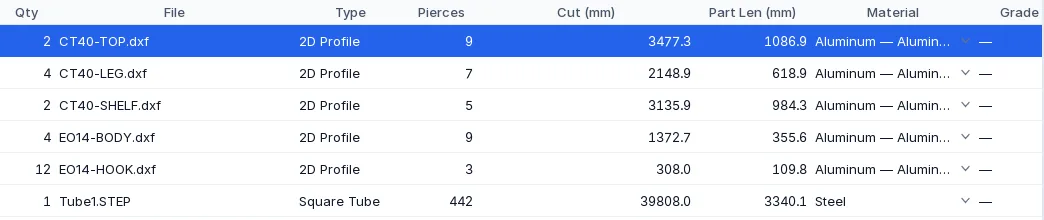
- Contours and circles, counted individually, which is what sets the pierce count for a flat part.
- Total cut length, summed across every contour rather than estimated from the outside dimensions.
- Bounding box, which decides whether the part fits the stock you have.
From there it is the same pricing engine as any other format: pierce rate, run time at the cut speed your own material curve gives, material on a whole-sheet or shared basis, plus programming, loading, travel, admin and whatever secondary operations the job needs.
DXF or STEP: which to ask the customer for
Take the DXF when the part is genuinely flat. It is the most common thing a customer has to hand, it is small, and for a plate part it carries everything the price depends on.
Ask for STEP when the part has depth. A STEP file carries the solid, and two things follow from that which a flat profile cannot give you: tube sections get detected and classified automatically, and a formed part gets unfolded so it can be priced on its developed flat pattern with a real bend allowance. The format support table sets out exactly which formats carry which.
There is no penalty for sending both. Lasertally quotes mixed jobs, flat and tube parts together, on one quote.
Thickness is the one thing a DXF cannot tell you
A DXF has no material and no thickness in it, because it is a flat drawing. That is not a limitation Lasertally works around silently. Material and thickness are a step you confirm, and until they are set the pre-quote checks will not pass: cut speed has to be known for that material at that thickness before anything can be priced. A missing figure shows as a gap in the panel, never as a zero in the total.
If your CAD only exports DWG or SAT
Neither is supported. Export DXF instead, which every CAD package that writes DWG can also do, and the part quotes exactly as described above. A guessed conversion in the middle of a quoting pipeline is a source of wrong numbers nobody notices until the job is on the machine.
Three steps, about thirty seconds
- Drop the DXF in. The profile is read and measured on your own machine.
- Confirm the metal. Material and thickness, which a DXF cannot supply. Rates come from your card.
- Send the quote. An itemized price with every figure traced to a measurement.
Quote your next DXF against your own rate card.
Sheet is $479 a month and includes flat parts from STEP, DXF and IGES. Full refund inside 14 days.