Five layouts, one answer
Auto nest does not run one algorithm and hand you what it got. It builds a portfolio and solves all of it, then picks.
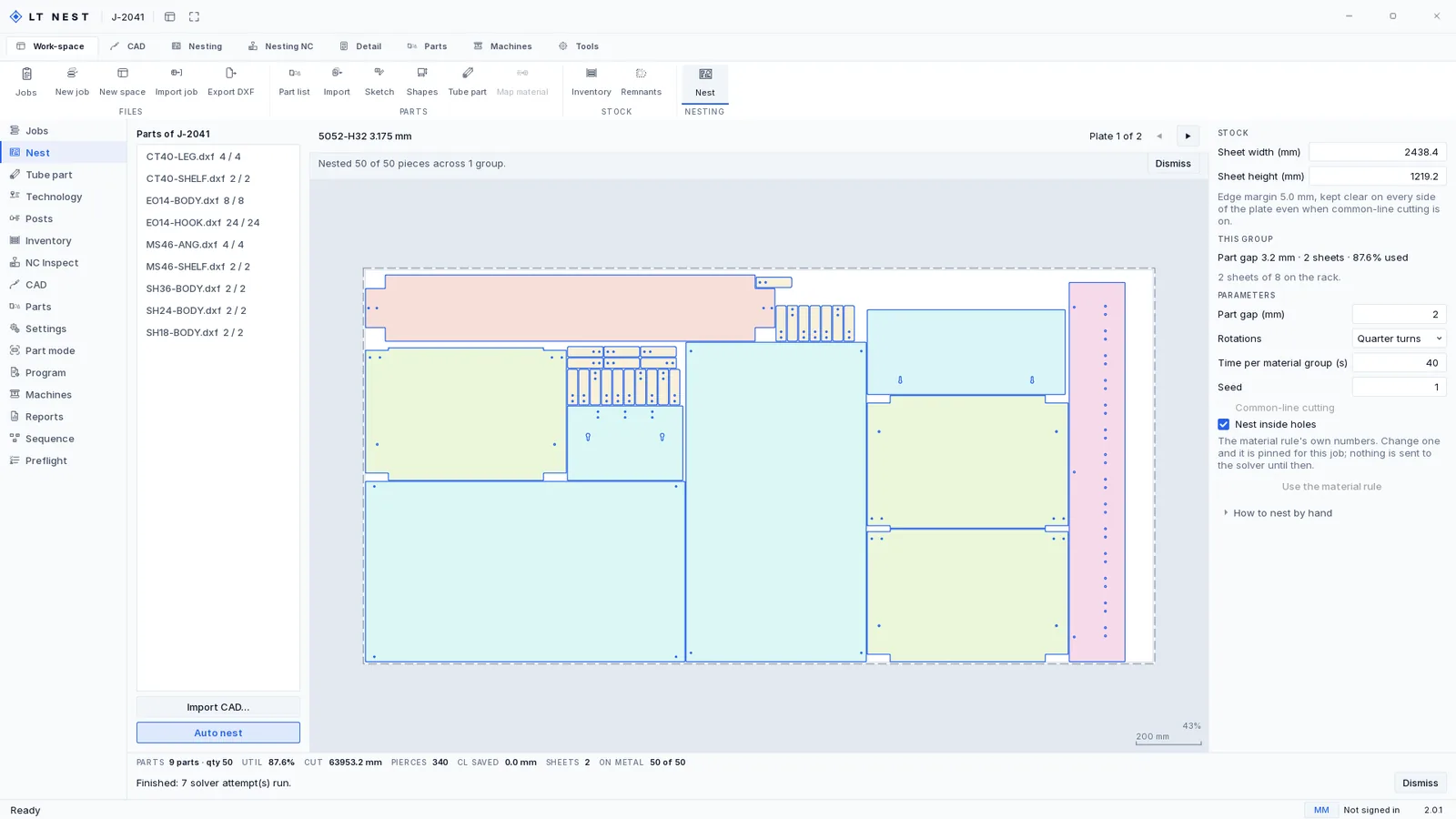
The rule layout. The same rule under a second seed. A two-way rotation. A modestly tighter gap that still sits at or above the family floor. And a conjoined pass that puts parts on a common line. Every racked offcut gets a candidate of its own on top of that, plus one sweep across the whole rack. On the plate above that came to seven attempts, and the page says so rather than making you take the first answer on trust.
Then it chooses, and the order it chooses in is the part worth knowing: fewer sheets first, utilisation second. A layout that is a percentage point tighter across three sheets loses to a layout that fits on two, because the second one is the cheaper job and the first one is the better-looking number.
- Rotations are one, two or four. One puts the part down as drawn. Two adds 180. Four adds 90 and 270. Every extra orientation is another placement to evaluate, so it is a setting rather than a cost everybody pays by default.
- Grain-locked material turns 180 degrees and never mirrors. A mirrored part on a directional finish is a part you make twice.
- Parts nest inside holes, and that is on by default. A large part with a large window in it is not one part, it is a part and some stock.
- A common line separates two parts by exactly one kerf. One cut then serves both edges, and the footer tells you how much cutting that saved.
Spacing comes from the metal
The gap between parts, the margin at the sheet edge and the width of a micro-joint come from the material family and the thickness. They are not three numbers you set once and then carry onto every job after it. Sixteen gauge mild steel and half-inch aluminium do not want the same spacing, and a nester that asks you for one number is asking you to remember which job it was set for.
On the plate above the rule gave a 3.2 mm gap between parts and kept 5 mm clear at every edge. It also declined to conjoin anything: aluminium's ceiling for common-line cutting is 3.0 mm and that plate is 3.175 mm, so the control is greyed out and the footer reads CL SAVED 0.0 mm. Forcing it on would override the metal's own rule, which is the opposite of what this section is about.
Every value is overridable, because your shop knows things a rule does not, and changing one pins it for that job rather than for every job after it. The margin has a floor of one millimetre, which is the one number the rules will not let you argue with.
Cut order is a safety rule, not a preference
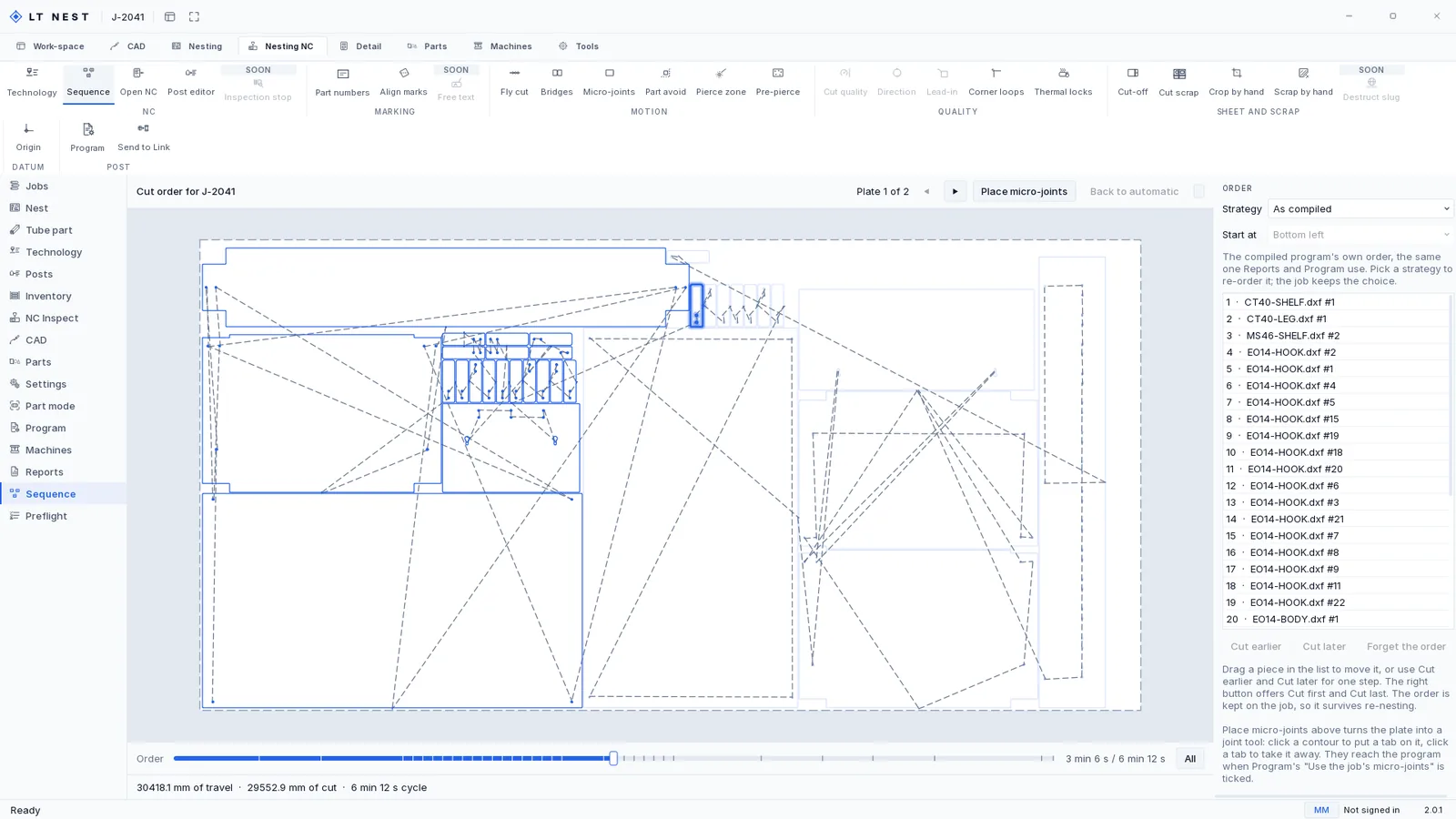
The moment a part's outline is finished, it is loose.
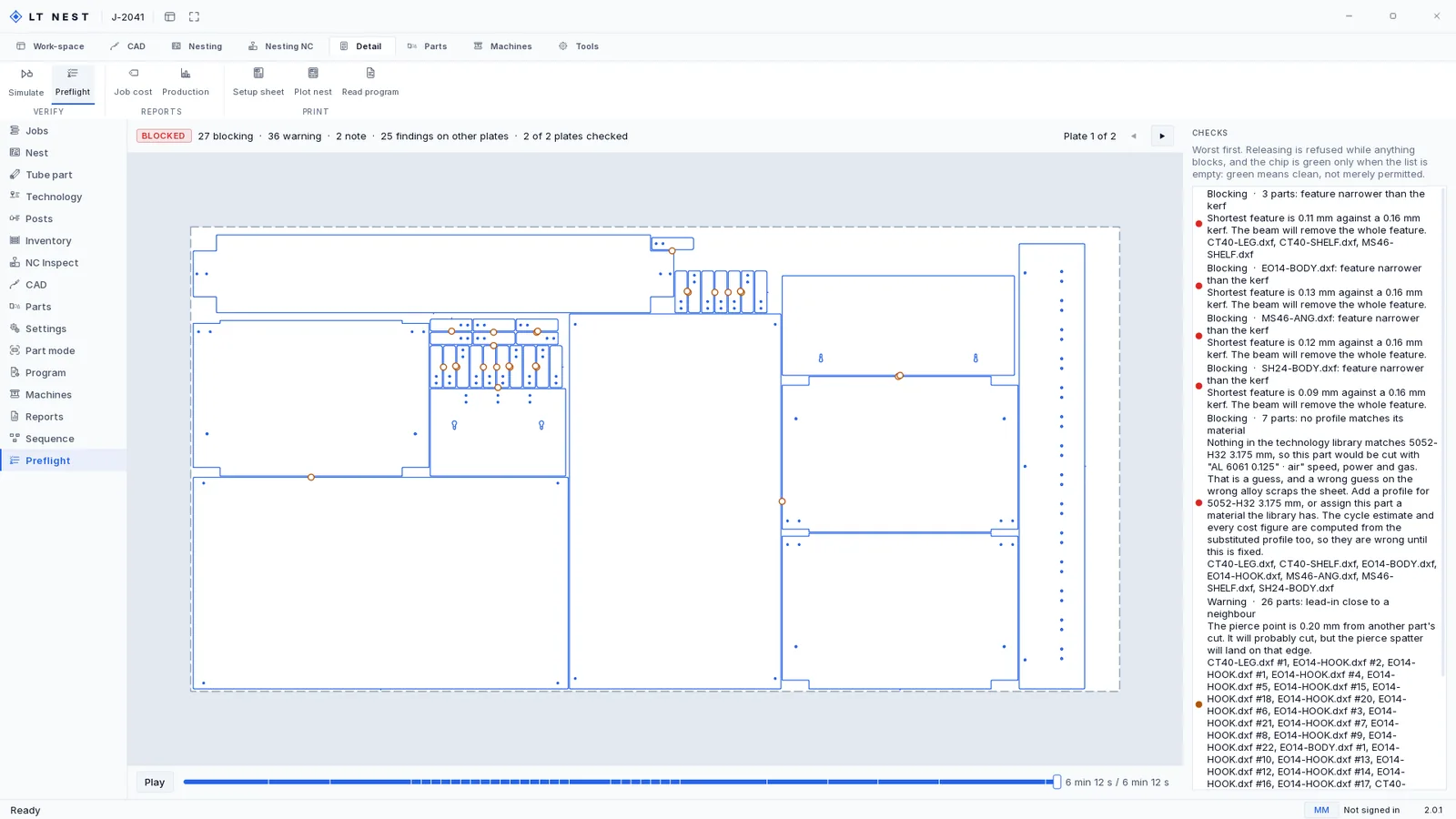
A loose part in a sheet can tilt, and a tilted part is in the path of the head. So the sequence treats that as a hard constraint rather than an option: holes before outlines, wraps before end cuts, nothing freed until everything that had to be cut inside it is done.
The order you are looking at is the compiled program's own, which is the same one the report and the program page use, so no two screens in the product can disagree about what the machine will do. Drag a piece to move it and the choice is kept on the job, so it survives a re-nest.
The same pass applies the cutting technology. Lead-ins go where they will not scar the part, the kerf is compensated so the finished dimension is the drawn dimension, and micro-joints go where a part needs holding.
Your stock, not a catalog
Most nesters ask what size sheet you want and lay parts on an idealised rectangle. That is a nest that is efficient against a sheet nobody has.
Lasertally Nest starts from the rack instead: the sheets in the building, the offcuts left over from every job before this one, and the tube sticks.
Two rules decide which piece it reaches for. Oldest first, so material does not age out in a corner, and the rack keeps the date each line arrived so that rule has something to work from. And the smallest piece that can still do the job, because spending a full sheet on a part a remnant could have carried is how a rack silts up with pieces too small to use and too big to throw away.